
General Mattis has been the most steadfast champion in Trump's cabinet of the US-India defence relationship. If Trump chooses a more pliable successor, the Pentagon's attention could go off India.
'A conventional war is not in fashion today and not seen as being able to deliver the objective.' 'Perhaps surgical strikes that are deeper, this time not on Pakistan's terrorist facilities, but on Pakistan army facilities.' 'The nation has to be prepared for losses.' 'War is not something that can be pussyfooted around.' 'If we go for limited number of posts in Kashmir, these are very difficult posts to capture and very difficult operations.' 'Be prepared for 200 to 300 killed.'

'By the time he came out after nearly five hours, he had a one-to-one conversation with the President, a delegation-level meeting, a reception, a dinner, a tour of the White House and a joint statement of a kind none of his predecessors ever had,' says Ambassador T P Sreenivasan.

SAARC countries are facing common challenges and they should cooperate with each other to address them, Home Minister Rajnath Singh said on Thursday, underlining that India is committed to reviving the grouping as a major forum to promote active regional collaboration.

New Delhi remains a priggish suitor to Washington's overtures, but it has begun appreciating potential tech benefits to ties with the US.
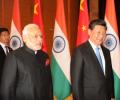
While the two sides' objectives may appear to differ, it is clear that both India and China are emphasising on the common minimum possible areas of cooperation between them, says Srikanth Kondapalli.

Pakistan-based terrorist outfits like Lashkar-e-Tayiba are likely to turn their attention to India with the drawdown of US forces from Afghanistan, a top Pentagon commander has told lawmakers.
'India appears to have stood its ground on strategic autonomy by resisting US pressure on Russia, China and Iran, but succumbed to the temptation to walk into a tighter embrace in defence cooperation, a high priority of the Trump administration,' notes Ambassador T P Sreenivasan.
